Introduction
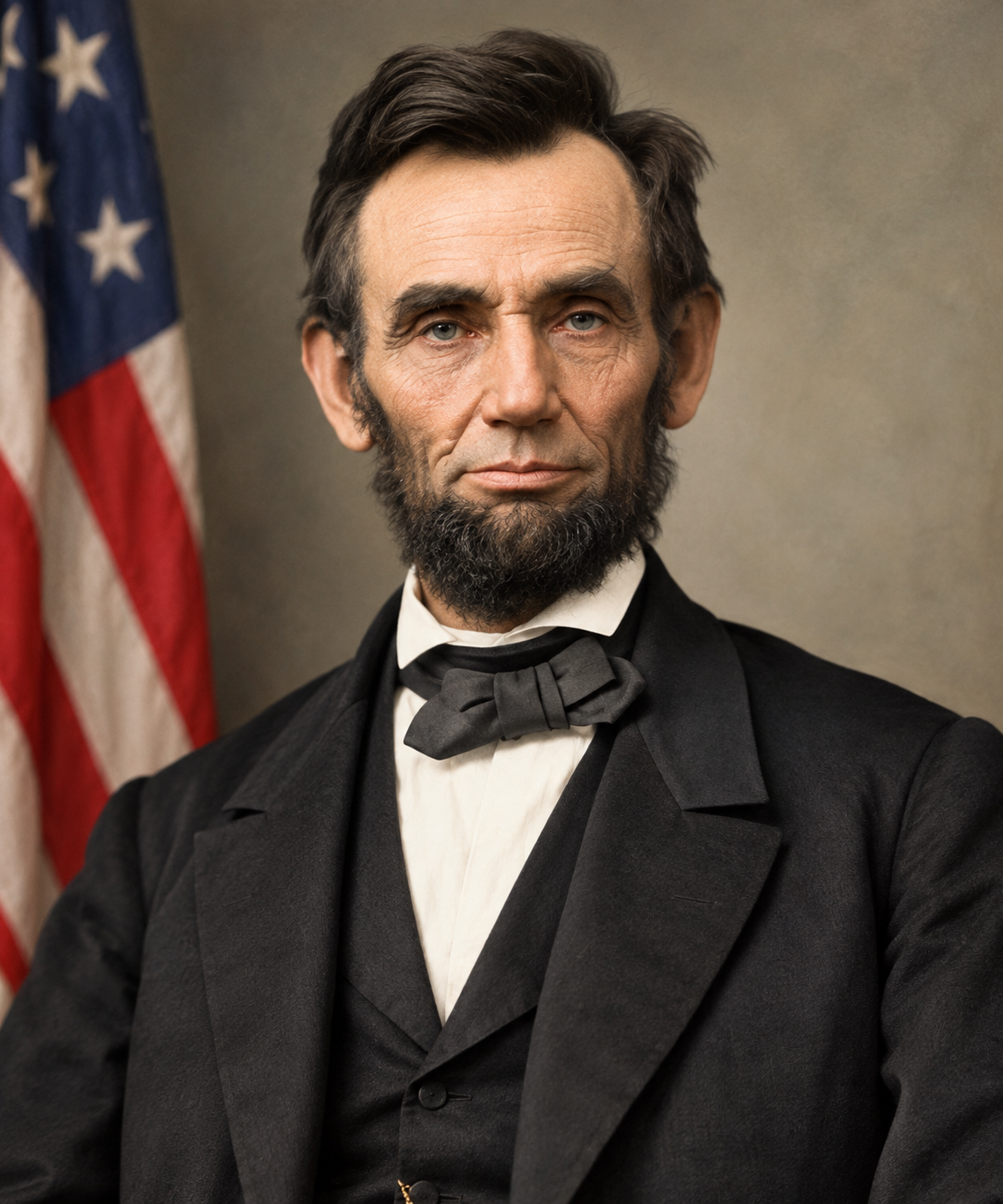
Abraham Lincoln a biography is written for students. No doubt Abraham Lincoln was one of the most important leaders in the history of the United States of America. He was the 16th President of the United States and served from 1861 to 1865. He became president at one of the most difficult times in American history. The country was divided over the issue of slavery, and several Southern states wanted to leave the Union.
Lincoln led the country during the American Civil War, which lasted from 1861 to 1865. Under his leadership, the Union defeated the Confederate states. He also played an important role in ending slavery in the United States.
Lincoln’s life is especially inspiring because he came from a poor family, had very little formal education, and faced many difficulties. Through reading, hard work, determination, and self-learning, he became a lawyer, politician, and finally the President of the United States.
He is remembered for his leadership, his speeches, his efforts to preserve the Union, and his role in the abolition of slavery. His life shows that a person can rise from humble beginnings through courage, learning, and determination.
1. Early Life and Family
Abraham Lincoln was born on February 12, 1809, in a one-room log cabin in Kentucky. His parents were Thomas Lincoln and Nancy Hanks Lincoln. He was the second child in the family. His elder sister was Sarah, while his younger brother Thomas died when he was an infant.
Lincoln’s family lived a simple life. His father worked as a farmer, carpenter, and cabinetmaker. The family faced financial difficulties, and his father had problems obtaining clear ownership of some of the farms he purchased.
In 1816, when Abraham was seven years old, the family moved from Kentucky to Indiana. They settled in the Little Pigeon Creek community. Life there was difficult because the land was heavily covered with forest, and much hard physical work was required.
Lincoln’s childhood was marked by both work and personal loss. His mother, Nancy Lincoln, died on October 5, 1818, when Abraham was only nine years old. The loss deeply affected the family. His father later married Sarah Bush Johnston, a widow with three children. Abraham became close to his stepmother and called her “Mama.”
Lincoln also suffered another family tragedy when his sister Sarah died during childbirth in 1828.
These early experiences made Lincoln familiar with hardship, responsibility, and loss from a very young age.
2. Education and Love of Reading
Lincoln did not receive much formal education. He attended schools only for short periods, and by the age of fifteen he had received less than a year of formal schooling in total.
However, Lincoln had a strong desire to learn. He was largely self-educated. He read whenever he had the opportunity and developed a lifelong love of books and knowledge.
As a young man, he read books on history, literature, politics, and law. His limited formal education did not prevent him from becoming an excellent speaker and lawyer. Instead, he educated himself through continuous reading and study.
This part of Lincoln’s life is particularly inspiring for students. His story shows that education is not limited to classrooms. Curiosity, reading, discipline, and a willingness to learn can also help a person develop knowledge and understanding.
The uploaded document records that Lincoln’s formal schooling was irregular, but his love of reading continued throughout his life.
3. Moving to Illinois
In 1830, members of the Lincoln family moved to Illinois. Abraham eventually began his independent life there.
In 1831, Lincoln moved to New Salem, Illinois, where he lived for several years. He worked at a general store and performed different kinds of jobs.
Lincoln was known for his physical strength and honesty. He also had a friendly personality and became known as a good storyteller.
In 1832, he entered public life by becoming a candidate for the Illinois House of Representatives. However, his political campaign was interrupted when he joined the Illinois Militia during the Black Hawk War. He became captain of his militia company, although he did not take part in combat.
He eventually returned to civilian life and tried several occupations. For a time, he became a partner in a general store, but the business failed and left him in debt.
Instead of giving up, Lincoln continued looking for a new path. He worked as a postmaster and county surveyor while studying law by himself.
4. Becoming a Lawyer
Lincoln decided to become a lawyer even though he had no formal legal education. He borrowed law books and studied them on his own.
He read important legal works such as Blackstone’s Commentaries and Chitty’s Pleadings. He later described his legal education by saying that he had “studied with nobody.”
Lincoln was admitted to the Illinois bar on September 9, 1836. He moved to Springfield and began practicing law.
He became a successful lawyer and handled many different kinds of cases. His work included transportation cases, railroad cases, and criminal cases.
One famous case involved William “Duff” Armstrong, who was accused of murder. Lincoln challenged the evidence of an eyewitness by using information about the position of the moon on the night of the crime. Armstrong was acquitted.
Lincoln’s legal career helped him develop skills that later became important in politics. He learned how to examine evidence, understand different viewpoints, speak clearly, and present arguments logically.
He also received a patent in 1849 for a device designed to help move riverboats through shallow water. The patent was never commercially developed, but it made Lincoln the only U.S. president to hold a patent.
5. Marriage and Family Life
Lincoln married Mary Todd on November 4, 1842. The couple lived in Springfield, Illinois.
They had four sons:
- Robert Todd Lincoln
- Edward Baker Lincoln
- William Wallace “Willie” Lincoln
- Thomas “Tad” Lincoln
Robert was the only one of their children to live to adulthood. Edward died in 1850, and Willie died in the White House in 1862. Their youngest son, Tad, died in 1871.
The deaths of his children were great personal tragedies for Lincoln. Despite his difficult family experiences, he was known to love children and spent time with his sons.
Lincoln’s family life therefore contained both happiness and deep sorrow.
6. Beginning of His Political Career
Lincoln entered politics in Illinois. In 1834, he was elected to the Illinois House of Representatives. He served four terms.
During his time in the state legislature, he supported improvements in transportation and infrastructure. He supported the development of canals and helped in the movement of the state capital from Vandalia to Springfield.
Lincoln later became a member of the Whig Party, which supported economic development, banks, transportation improvements, and other modernization measures.
In 1846, Lincoln was elected to the U.S. House of Representatives. He served there from 1847 to 1849.
During his time in Congress, Lincoln spoke against the Mexican-American War and supported a proposal to prevent slavery from spreading into territories gained from Mexico.
After serving one term in Congress, he returned to his law practice in Illinois.
7. Lincoln and the Issue of Slavery
The most important political issue in Lincoln’s career was slavery.
During the 1850s, disagreement over slavery became more serious in the United States. The Kansas-Nebraska Act of 1854 allowed people in those territories to decide whether slavery would be permitted. Lincoln strongly opposed the spread of slavery into the territories.
He returned to active politics and became an important leader of the new Republican Party.
Lincoln did not initially call for the immediate abolition of slavery everywhere. His major political position was against the extension of slavery into new territories. His views developed during the political crisis of the 1850s.
The issue became even more serious after the Dred Scott decision of 1857. Lincoln criticized the decision and argued that the principle of equality in the Declaration of Independence was important to American political life.
8. Lincoln-Douglas Debates
In 1858, Lincoln challenged Stephen A. Douglas for a seat in the U.S. Senate from Illinois.
The two men held a series of seven famous debates. Thousands of people attended these debates, and newspapers across the country reported on them.
Lincoln spoke strongly about the dangers created by the division between free states and slave states.
In his famous House Divided Speech, Lincoln said:
“A house divided against itself cannot stand.”
His argument was that the United States could not remain permanently divided between states where slavery existed and states where it did not.
Although Lincoln lost the Senate election, the debates made him known across the country. His clear arguments and powerful speaking style increased his national reputation.
9. The Cooper Union Speech
In February 1860, Lincoln gave an important speech at Cooper Union in New York City.
In this speech, he discussed the views of America’s founders and argued against the spread of slavery into the territories.
The speech increased his national reputation. He showed that he could speak effectively to a large audience outside the Midwest.
Soon, Lincoln became a serious candidate for the Republican presidential nomination.
10. Election as President
In May 1860, Lincoln was nominated as the Republican candidate for President of the United States.
The presidential election was held on November 6, 1860. Lincoln won the election and became the first Republican president of the United States.
His election caused great fear and anger in many Southern slave states. Several Southern states began leaving the Union and formed the Confederate States of America.
When Lincoln became president, the country was moving rapidly toward civil war.
11. Lincoln Becomes President
Lincoln took office on March 4, 1861.
In his First Inaugural Address, he tried to reassure the Southern states that he did not intend to abolish slavery in states where it already existed. At the same time, he made it clear that he would not accept the breaking apart of the Union.
His speech ended with an appeal for friendship and unity rather than hatred.
Lincoln faced an extremely difficult situation. The country was divided, several states had already seceded, and military conflict was becoming increasingly likely.
His leadership would soon be tested by the greatest crisis in American history.
12. The American Civil War
On April 12, 1861, Confederate forces attacked Fort Sumter in South Carolina. This marked the beginning of the American Civil War.
Lincoln called for troops to defend the Union. More Southern states then joined the Confederacy.
As President and Commander-in-Chief, Lincoln had to make many difficult decisions. He closely followed military operations and played an important role in choosing military commanders and developing Union strategy.
The war was long and extremely destructive. Thousands of soldiers and civilians lost their lives.
Lincoln also faced political disagreements within the Union. Some people wanted stronger action against slavery, while others wanted the war to focus mainly on preserving the Union.
Despite these difficulties, Lincoln continued to lead the country.
13. The Emancipation Proclamation
One of Lincoln’s most important actions was the Emancipation Proclamation.
On September 22, 1862, Lincoln announced a preliminary proclamation stating that enslaved people in areas still in rebellion would be declared free from January 1, 1863.
On January 1, 1863, he issued the final Emancipation Proclamation.
The proclamation declared enslaved people in the states still in rebellion to be free. It also changed the character of the Civil War by making emancipation an important Union war objective.
The document in the source explains that Lincoln had earlier stated that his main wartime objective was to save the Union, but circumstances during the war led to the Emancipation Proclamation.
Lincoln also supported further constitutional action to abolish slavery throughout the United States.
14. The Gettysburg Address
On November 19, 1863, Lincoln delivered his famous Gettysburg Address at the dedication of a military cemetery at Gettysburg, Pennsylvania.
The speech was very short, but it became one of the most famous speeches in American history.
Lincoln spoke about democracy, equality, freedom, and the need to preserve the Union. He connected the Civil War to the larger principles on which the United States had been founded.
The Gettysburg Address remains important because it expresses Lincoln’s belief that the country should move toward a new birth of freedom.
The uploaded document identifies the Gettysburg Address as one of Lincoln’s most famous contributions during the Civil War.
15. The Thirteenth Amendment
Lincoln supported a constitutional amendment to permanently abolish slavery throughout the United States.
The Thirteenth Amendment was approved by Congress in 1865 and was later ratified by the required number of states in December 1865.
It abolished slavery and involuntary servitude, except as punishment for a crime.
This was an important step because the Emancipation Proclamation was a wartime measure applying to areas in rebellion, while the Thirteenth Amendment established abolition in the Constitution.
16. Re-election in 1864
The presidential election of 1864 took place while the Civil War was still continuing.
Lincoln was re-elected. His victory came after important Union military successes, including the capture of Atlanta.
After his re-election, Lincoln began thinking more seriously about how to rebuild the country after the war.
He wanted to reunite the country rather than continue hatred between the North and South.
17. Lincoln’s Second Inaugural Address
Lincoln’s Second Inaugural Address, delivered on March 4, 1865, is another important example of his leadership.
The speech focused on the terrible cost of the Civil War and the need for peace and reconciliation.
Lincoln called upon Americans to move forward without hatred and to heal the wounds created by the war.
His approach to the defeated South was not simply one of revenge. He was concerned with restoring the Union and rebuilding the country.
18. End of the Civil War
The Civil War was approaching its end in the spring of 1865.
On April 9, 1865, Confederate General Robert E. Lee surrendered to Union General Ulysses S. Grant at Appomattox Court House.
The surrender marked the effective end of the main Confederate military resistance.
Lincoln now faced the enormous task of helping the country recover from the war.
He wanted Reconstruction to bring the Southern states back into the Union. His approach included relatively generous terms for many former Confederates who would swear loyalty to the United States.
Sadly, Lincoln did not live long enough to complete this work.
19. Assassination and Death
On the evening of April 14, 1865, Lincoln and his wife, Mary Todd Lincoln, attended a play at Ford’s Theatre in Washington, D.C.
During the performance, the actor John Wilkes Booth entered Lincoln’s theater box and shot him.
Lincoln was seriously wounded and was taken to Petersen House, across the street from the theatre.
He remained unconscious for several hours and died at 7:22 a.m. on April 15, 1865.
Lincoln became the first U.S. president to be assassinated.
His death shocked the nation. His body was later taken on a funeral train to Springfield, Illinois, where he was buried.
20. Legacy of Abraham Lincoln
Abraham Lincoln’s influence continued long after his death.
He is remembered for leading the United States through the Civil War, preserving the Union, and supporting the abolition of slavery.
He is also remembered for his powerful speeches, especially the Gettysburg Address and his two inaugural addresses.
Lincoln’s life has become an example of how a person from a poor background can achieve great things through education, determination, hard work, and public service.
His image can be found on the U.S. five-dollar bill and penny. The famous Lincoln Memorial in Washington, D.C., was built in his honor. His name has also been given to many towns, cities, counties, and other institutions. A sculpture of Lincoln is also included at Mount Rushmore.
Lincoln’s reputation has also been discussed from different historical perspectives. While many people have praised his leadership and his role in ending slavery, historians and writers have also debated some of his political views and attitudes toward race. These discussions are part of the continuing study of his life and times.
21. Qualities That Made Lincoln an Important Leader
Lincoln’s life teaches several valuable lessons to students.
1. Love of Learning
Lincoln had very little formal education, but he never stopped learning. He read books and studied subjects on his own.
2. Hard Work
He worked at different jobs before becoming a lawyer and politician. He did not allow failure to stop him.
3. Determination
Lincoln faced political defeats, financial problems, and personal tragedies. Still, he continued working toward his goals.
4. Leadership
As president, he had to make difficult decisions during a national crisis. He remained focused on preserving the Union.
5. Communication
His speeches were simple, powerful, and meaningful. The Gettysburg Address remains an important example of effective public speaking.
6. Commitment to Freedom
Lincoln played a major role in the movement that ended slavery in the United States. His support for the Thirteenth Amendment helped establish abolition in the Constitution.
Conclusion
Abraham Lincoln’s life is the story of a poor boy who became one of the most important leaders in American history. Born in a simple log cabin, he received very little formal education but developed himself through reading and hard work.
He worked as a shopkeeper, postmaster, surveyor, lawyer, state legislator, and member of Congress before becoming President of the United States.
As president, Lincoln faced the greatest crisis in the nation’s history. The American Civil War threatened to destroy the Union. He led the country through four difficult years of war and played a major role in the abolition of slavery.
His Emancipation Proclamation, Gettysburg Address, support for the Thirteenth Amendment, and efforts toward national reconciliation remain important parts of his historical legacy.
Lincoln was assassinated on April 15, 1865, only days after the major Confederate surrender. His death was a great loss to the country.
Today, Abraham Lincoln is remembered not only as a president but also as a symbol of perseverance, freedom, equality, leadership, and service to the nation. His life gives an important message to young people: a difficult beginning does not have to decide the future. With determination, self-education, courage, and hard work, a person can make a lasting difference in the world.
Important Dates
| Year/Date | Event |
| February 12, 1809 | Abraham Lincoln was born in Kentucky |
| 1816 | His family moved to Indiana |
| 1830 | Lincoln moved to Illinois |
| 1834 | Elected to the Illinois House of Representatives |
| 1836 | Admitted to the Illinois bar |
| 1842 | Married Mary Todd |
| 1847–1849 | Served in the U.S. House of Representatives |
| 1854 | Opposed the Kansas-Nebraska Act |
| 1858 | Lincoln-Douglas debates |
| 1860 | Elected President of the United States |
| March 4, 1861 | Became President |
| April 12, 1861 | Civil War began at Fort Sumter |
| January 1, 1863 | Emancipation Proclamation took effect |
| November 19, 1863 | Delivered the Gettysburg Address |
| 1864 | Re-elected President |
| January 31, 1865 | Congress passed the Thirteenth Amendment |
| April 9, 1865 | Lee surrendered at Appomattox |
| April 14, 1865 | Lincoln was shot at Ford’s Theatre |
| April 15, 1865 | Lincoln died |
| December 1865 | Thirteenth Amendment was ratified |
Final Message
Abraham Lincoln’s life teaches us that knowledge, determination, courage, and service can help an ordinary person achieve extraordinary things.
Reference :
Sources
See also: Bibliography of Abraham Lincoln
- Amar, Akhil Reed (2025). Born Equal: Remaking America’s Constitution, 1840 to 1920. Basic Books. ISBN 9781541605190.
- Avlon, John (2023). Lincoln and the Fight for Peace. Simon & Schuster. ISBN 9781982108137.
- Baker, Jean H. (1989). Mary Todd Lincoln: A Biography. W. W. Norton & Company. ISBN 9780393305869.
- Bartelt, William E. (2008). There I Grew Up: Remembering Abraham Lincoln’s Indiana Youth. Indiana Historical Society Press. ISBN 9780871952639.
- Belz, Herman (1998). Abraham Lincoln, Constitutionalism, and Equal Rights in the Civil War Era. Fordham University Press. ISBN 9780823217687.
- Belz, Herman (2014). “Lincoln, Abraham”. In Frohnen, Bruce; Beer, Jeremy; Nelson, Jeffrey O. (eds.). American Conservatism: An Encyclopedia. Open Road Media. ISBN 9781932236439.
- Blue, Frederick J. (1987). Salmon P. Chase: A Life in Politics. Kent State University Press. ISBN 9780873383400.
- Bollet, Alfred (2004). Plagues & Poxes: The Impact of Human History on Epidemic Disease. Springer. ISBN 9781888799798.
- Boritt, Gabor S.; Pinsker, Matthew (2002). “Abraham Lincoln”. In Graff, Henry (ed.). The Presidents: A Reference History (7th ed.). Macmillan. ISBN 9780684805511.
- Boutwell, Jeffrey (2025). Boutwell: Radical Republican and Champion of Democracy. W. W. Norton & Company.
- Braden, Waldo (1993). Abraham Lincoln: Public Speaker. Louisiana State University Press. ISBN 9780807118528.
- Brownlee, W. Elliot (2004). Federal Taxation in America: A Short History. Cambridge University Press. ISBN 9780521545204.
- Bulla, David W.; Borchard, Gregory A. (2010). Journalism in the Civil War Era. Peter Lang. ISBN 9781433107221.
- Burlingame, Michael (2008). Abraham Lincoln: A Life. Johns Hopkins University Press. ISBN 9780801894671.
- Carwardine, Richard J. (2003). Lincoln. Pearson Longman. ISBN 9780582032798.
- Carwardine, Richard; Sexton, Jay, eds. (2011). The Global Lincoln. Oxford University Press. ISBN 9780195379112.
- Cashin, Joan E. (2002). The War was You and Me: Civilians in the American Civil War. Princeton University Press. ISBN 9780691091747.
- Chesebrough, David B. (1994). No Sorrow Like Our Sorrow: Northern Protestant Ministers and the Assassination of Lincoln. Kent State University Press. ISBN 9780873384919.
- Clodfelter, Micheal (1998). The Dakota War: The United States Army versus the Sioux, 1862–1865. McFarland. ISBN 9780786404193.
- Collea, Joseph D. Jr. (2018). New York and the Lincoln Specials: The President’s Pre-Inaugural and Funeral Trains Cross the Empire State. McFarland. ISBN 9781476633244.
- Corning, Amy; Schuman, Howard (2015). Generations and Collective Memory. University of Chicago Press. ISBN 9780226282831.
- Craughwell, Thomas (2009). Stealing Lincoln’s Body. Harvard University Press. ISBN 9780674029972.
- Dennis, Matthew (2018). Red, White, and Blue Letter Days: An American Calendar. Cornell University Press. ISBN 9781501723704.
- Diamant, Rolf; Carr, Ethan (2022). Olmsted and Yosemite: Civil War, Abolition, and the National Park Idea. Library of America Landscape History. ISBN 9781952620348.
- Donald, David Herbert (1996). Lincoln. Simon & Schuster. ISBN 9780684825359.
- Doyle, Don H. (2015). The Cause of All Nations: An International History of the American Civil War. Basic Books. ISBN 9780465029679.
- Edgar, Walter B. (1998). South Carolina: A History. University of South Carolina Press. ISBN 9781570032554.
- Emerson, Jason (2009). Lincoln the Inventor. Southern Illinois University Press. ISBN 9780809328987.
- Field, Ron (2011). Garibaldi: Leadership, Strategy, Conflict. Osprey Publishing. ISBN 9781849083218.
- Finkelman, Paul (2018). “Military conflict on the Minnesota homefront”. In Finkelman, Paul; Kennon, Donald (eds.). Civil War Congress and the Creation of Modern America. Ohio University Press. pp. 118–167. ISBN 9780821423387.
- Foner, Eric (2010). The Fiery Trial: Abraham Lincoln and American Slavery. W. W. Norton & Company. ISBN 9780393066180.
- Goodrich, Thomas (2005). The Darkest Dawn: Lincoln, Booth, and the Great American Tragedy. Indiana University Press. ISBN 9780253345677.
- Goodwin, Doris Kearns (2005). Team of Rivals: The Political Genius of Abraham Lincoln. Simon & Schuster. ISBN 9780684824901.
- Graebner, Norman (1959). “Abraham Lincoln: conservative statesman”. In Basler, Roy Prentice (ed.). The Enduring Lincoln: Lincoln Sesquicentennial Lectures at the University of Illinois. University of Illinois Press. OCLC 428674.
- Green, Michael S. (2021). Lincoln and Native Americans. Southern Illinois University Press. ISBN 9780809338252.
- Greenberg, Amy (2012). A Wicked War: Polk, Clay, Lincoln, and the 1846 U.S. Invasion of Mexico. Alfred A. Knopf. ISBN 9780307592699.
- Guelzo, Allen C. (1999). Abraham Lincoln: Redeemer President. Wm. B. Eerdmans Publishing Company. ISBN 9780802838728.
- Guelzo, Allen C. (2004). Lincoln’s Emancipation Proclamation: The End of Slavery in America. Simon & Schuster. ISBN 9780743221825.
- Guelzo, Allen C. (2009). “Abraham Lincoln and the Doctrine of Necessity”. Abraham Lincoln as a Man of Ideas. Southern Illinois University. pp. 27–48. ISBN 9780809386376.
- Harrison, Lowell (2010). Lincoln of Kentucky. University Press of Kentucky. ISBN 9780813129402.
- Harris, William C. (2007). Lincoln’s Rise to the Presidency. University Press of Kansas. ISBN 9780700615209.
- Harris, William C. (2011). Lincoln and the Border States: Preserving the Union. University Press of Kansas. ISBN 9780700620562.
- Havers, Grant N. (2009). Lincoln and the Politics of Christian Love. University of Missouri Press. ISBN 9780826218575.
- Heidler, David Stephen; Heidler, Jeanne T.; Coles, David J., eds. (2002). Encyclopedia of the American Civil War: A Political, Social, and Military History. W. W. Norton & Company. ISBN 9780393047585.
- Heidler, David Stephen; Heidler, Jeanne T. (2006). The Mexican War. Greenwood Publishing Group. ISBN 9780313327926.
- Herring, George (2008). From Colony to Superpower: U.S. Foreign Relations Since 1776. Oxford University Press. ISBN 9780195078220.
- Hodes, Martha (2015). Mourning Lincoln. Yale University Press. ISBN 9780300213560.
- Holzer, Harold (2004). Lincoln at Cooper Union: The Speech That Made Abraham Lincoln President. Simon & Schuster. ISBN 9780743299640.
- Jaffa, Harry V. (2000). A New Birth of Freedom: Abraham Lincoln and the Coming of the Civil War. Rowman & Littlefield. ISBN 9780847699520.
- Jividen, Jason (2011). Claiming Lincoln: Progressivism, Equality, and the Battle for Lincoln’s Legacy in Presidential Rhetoric. Cornell University Press. ISBN 9781501756870.
- Kelley, Robin D. G.; Lewis, Earl (2005). To Make Our World Anew. Vol. I: A History of African Americans to 1880. Oxford University Press. ISBN 9780198040064.
- Kent, David (2022). Lincoln: The Fire of Genius. Globe Pequot. ISBN 9781493063888.
- Koehn, Nancy (2017). Forged in Crisis: The Making of Five Legendary Leaders. Scribner. ISBN 9781501174445.
- Lamb, Brian P.; Swain, Susan, eds. (2008). Abraham Lincoln: Great American Historians on Our Sixteenth President. PublicAffairs. ISBN 9781586486761.
- Lincoln, Abraham (1953). Collected Works of Abraham Lincoln. Vol. 4. Rutgers University Press.
- Lundberg, James M. (2019). Horace Greeley: Print, Politics, and the Failure of American Nationhood. Johns Hopkins University Press. ISBN 9781421432885.
- Madison, James H. (2014). Hoosiers: A New History of Indiana. Indiana University Press. ISBN 9780253013088.
- Mahin, Dean (1999). One War at a Time: The International Dimensions of the American Civil War. Brassey’s. ISBN 9781574882094.
- Manning, Alan (2016). Father Lincoln. Lyons Press. ISBN 9781493018239.
- Mansch, Larry D. (2005). Abraham Lincoln, President-elect: The Four Critical Months from Election to Inauguration. McFarland. ISBN 9780786420261.
- Mansfield, Stephen (2012). Lincoln’s Battle with God. Thomas Nelson. ISBN 9781595553096.
- Marvel, William (2008). Lincoln’s Darkest Year: The War in 1862. Houghton Mifflin Harcourt. ISBN 9780547523866.
- McClintock, Russell (2008). Lincoln and the Decision for War. University of North Carolina Press. ISBN 9780807886328.
- McGinty, Brian (2015). Lincoln’s Greatest Case: The River, the Bridge, and the Making of America. W. W. Norton & Company. ISBN 9780871407856.
- McGovern, George S. (2009). Abraham Lincoln: The 16th President, 1861–1865. Henry Holt and Company. ISBN 9780805083453.
- McPherson, James M. (1992). Abraham Lincoln and the Second American Revolution. Oxford University Press. ISBN 9780195076066.
- McPherson, James M. (2009). Abraham Lincoln. Oxford University Press. ISBN 9780195374520.
- Meacham, Jon (2022). And There Was Light: Abraham Lincoln and the American Struggle. Random House. ISBN 9780553393965.
- Murrin, John (2006). Liberty, Equality, Power: A History of the American People. Thomson Wadsworth. ISBN 9780495915881.
- Myers, Marshall (2018). The Rhetoric of Lincoln’s Letters. McFarland. ISBN 9781476631158.
- Neely, Mark; Holzer, Harold (2006). The Lincoln Family Album. Southern Illinois University Press. ISBN 9780809327133.
- Noll, Mark A. (2002). America’s God: From Jonathan Edwards to Abraham Lincoln. Oxford University Press. ISBN 9780195151114.
- Paludan, Phillip Shaw (1994). The Presidency of Abraham Lincoln. University Press of Kansas. ISBN 9780700606719.
- Peck, Garrett (2015). Walt Whitman in Washington, D.C.: The Civil War and America’s Great Poet. The History Press. ISBN 9781626199736.
- Peterson, Merrill (1995). Lincoln in American Memory. Oxford University Press. ISBN 9780198023043.
- Potter, David M. (1977). The Impending Crisis: America Before the Civil War, 1848–1861. HarperCollins. ISBN 9780061319297.
- Reynolds, David S. (2020). Abe: Abraham Lincoln in His Times. Penguin. ISBN 9780698154513.
- Samuels, Shirley (2012). The Cambridge Companion to Abraham Lincoln. Cambridge Companions to American Studies. Cambridge University Press. ISBN 9780521193160.
- Sandburg, Carl (2002). Abraham Lincoln: The Prairie Years and the War Years. Houghton Mifflin Harcourt. ISBN 9780156027526.
- Schaffer, Jeffrey P. (1999). Yosemite National Park: A Natural History Guide to Yosemite and Its Trails. Wilderness Press. ISBN 9780899972442.
- Schroeder-Lein, Glenna R. (2012). Lincoln and Medicine. Southern Illinois University Press. ISBN 9780809331949.
- Schwartz, Barry (2000). Abraham Lincoln and the Forge of National Memory. University of Chicago Press. ISBN 9780226741970.
- Schwartz, Barry (2008). Abraham Lincoln in the Post-Heroic Era: History and Memory in Late Twentieth-Century America. University of Chicago Press. ISBN 9780226741888.
- Sears, Stephen W. (1999) [1988]. George B. McClellan: The Young Napoleon. Da Capo Press. ISBN 9780306809132.
- Silver, David (1998). Lincoln’s Supreme Court. University of Illinois Press. ISBN 9780252067198.
- Simon, Paul (1990). Lincoln’s Preparation for Greatness: The Legislative Years. University of Illinois Press. ISBN 9780252002038.
- Smith, Robert C. (2010). Conservatism and Racism, and Why in America They Are the Same. State University of New York Press. ISBN 9781438432335.
- Steers, Edward Jr. (2010). The Lincoln Assassination Encyclopedia. HarperCollins. ISBN 9780061787751.
- Striner, Richard (2006). Father Abraham: Lincoln’s Relentless Struggle to End Slavery. Oxford University Press. ISBN 9780195183061.
- Taranto, James; Leo, Leonard, eds. (2004). Presidential Leadership: Rating the Best and the Worst in the White House. Free Press. ISBN 9780743254335.
- Thomas, Benjamin P. (2008). Abraham Lincoln: A Biography. Southern Illinois University Press. ISBN 9780809328871.
- Thomas, Benjamin Platt; Hyman, Harold Melvin (1962). Stanton: The Life and Times of Lincoln’s Secretary of War. Alfred A. Knopf.
- Thompson, Todd (2015). The National Joker: Abraham Lincoln and the Politics of Satire. Southern Illinois University Press. ISBN 9780809334230.
- Trefousse, Hans L. (1989). Andrew Johnson: A Biography. W. W. Norton & Company. ISBN 9780393317428.
- Trefousse, Hans L. (1999). “Lincoln and race relations”. In Hubbard, Charles (ed.). Abraham Lincoln and His Contemporaries. Mercer University Press. pp. 87–100. ISBN 9780865546271.
- Tucker, Spencer (2014). Battles that Changed American History. ABC-CLIO. ISBN 9781440828621.
- Vile, John R. (2003). “Lincoln, Abraham (1809–1865)”. Encyclopedia of Constitutional Amendments: Proposed Amendments, and Amending Issues 1789–2002 (2nd ed.). ABC-CLIO. ISBN 9781851094288.
- Vorenberg, Michael (2001). Final Freedom: The Civil War, the Abolition of Slavery, and the Thirteenth Amendment. Cambridge University Press. ISBN 9780521652674.
- Weisman, Steven R. (2002). The Great Tax Wars: Lincoln to Wilson—The Fierce Battles over Money and Power That Transformed the Nation. Simon & Schuster. ISBN 9780684850689.
- White, Ronald C. (2009). A. Lincoln: A Biography. Random House. ISBN 9781588367754.
- White, Jonathan W. (2011). Abraham Lincoln and Treason in the Civil War: The Trials of John Merryman. Louisiana State University Press. ISBN 9780807142158.
- Wills, Garry (2012). Lincoln at Gettysburg: The Words that Remade America. Simon & Schuster. ISBN 9781439126455.
- Wilson, Douglas L. (1999). Honor’s Voice: The Transformation of Abraham Lincoln. Alfred A. Knopf. ISBN 9780307765819.
- Winik, Jay (2006) [2001]. April 1865: The Month That Saved America. HarperCollins. ISBN 9780060899684.
- Winkle, Kenneth J. (2001). The Young Eagle: The Rise of Abraham Lincoln. Taylor Trade Publishing. ISBN 9781461734369.
- Witt, John Fabian (2013). Lincoln’s Code: The Laws of War in American History. Free Press. ISBN 9781416576174.
- Winkle, Kenneth J. (2011). Abraham and Mary Lincoln. Southern Illinois University Press. ISBN 9780809379996.
- Work, David (2024). Lincoln’s Political Generals. University of Illinois Press. ISBN 9780252056888.
- Young, Alfred C. (2013). Lee’s Army during the Overland Campaign: A Numerical Study. Louisiana State University Press. ISBN 9780807151723.
- Zarefsky, David (1993). Lincoln, Douglas, and Slavery: In the Crucible of Public Debate. University of Chicago Press. ISBN 9780226978765.
Disclaimer : Article and image in made with Chat GPT and studying other journals.
Also read :