Introduction
Yes Northern lights , Nature is full of beautiful and surprising events. Some natural events are common, while others are seen only in special places and under special conditions. One of the most beautiful natural phenomena in the world is the Northern Lights, also known as the Aurora Borealis.
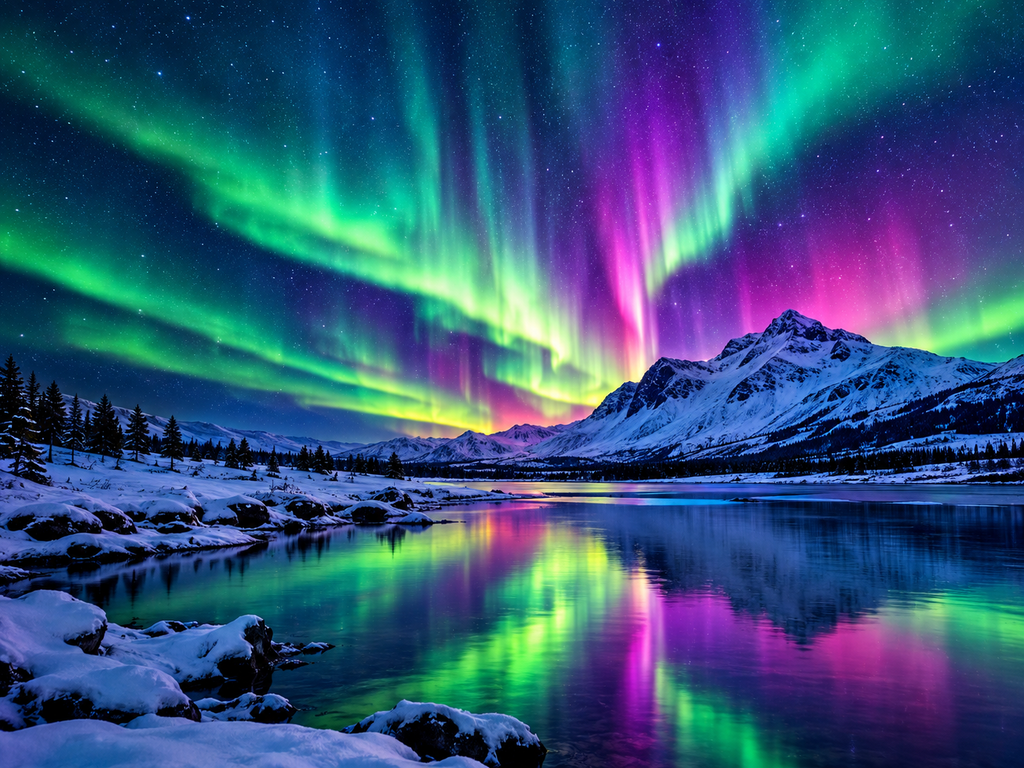
Note : Above image is created with the help of AI on 22nd September 2026
The Northern Lights are colourful lights that appear in the night sky, especially in regions close to the North Pole. They may look like glowing green curtains, moving waves, shining rays, or colourful arcs across the sky. Sometimes they appear green, while at other times they may show red, purple, pink, blue, or a combination of several colours.
Although the Northern Lights may look magical, they are actually the result of scientific processes involving the Sun, solar wind, Earth’s magnetic field, and gases in the upper atmosphere.

Note : Above image is created with the help of AI on 22nd September 2026
The word “aurora” is also used for similar lights seen near the South Pole. In the northern region, the phenomenon is called Aurora Borealis, or Northern Lights. In the southern region, it is called Aurora Australis, or Southern Lights.
What Are the Northern Lights?
The Northern Lights are a natural light display that takes place high above Earth’s surface. They are caused mainly by charged particles that come from the Sun and interact with gases in Earth’s upper atmosphere.
The Sun is constantly releasing a stream of tiny particles into space. This stream is called the solar wind. Some of these particles are electrically charged. When they reach Earth, our planet’s magnetic field guides many of them toward the polar regions.
When these energetic particles enter the upper atmosphere, they collide with atoms and molecules of gases such as oxygen and nitrogen. These collisions give energy to the gas particles. After receiving this energy, the particles release it in the form of light.
This light is what we see as an aurora.
Therefore, the Northern Lights are not clouds, smoke, or reflections. They are a natural light display produced by interactions between particles from the Sun and gases in Earth’s atmosphere.
Why Are They Called Aurora Borealis?
The scientific name for the Northern Lights is Aurora Borealis.
The word “aurora” comes from the name of the Roman goddess of dawn. The word “borealis” is connected with the north. Therefore, Aurora Borealis can be understood as the northern aurora or northern dawn.
The term “aurora borealis” was used in historical scientific descriptions many centuries ago. The phenomenon had been observed by people long before scientists understood its true cause.
Today, the simpler name Northern Lights is commonly used when talking about Aurora Borealis.
How Are the Northern Lights Formed?
The formation of the Northern Lights can be explained in a few simple steps.
Step 1: Energy Comes from the Sun
The process begins with the Sun. The Sun is an enormous ball of extremely hot gases. It constantly releases energy and streams of charged particles into space.
This continuous flow of particles is called the solar wind.
Sometimes the Sun becomes more active and releases especially large amounts of energy and particles. One important event is called a coronal mass ejection, or CME. Such events can send huge clouds of charged particles toward Earth.
Step 2: Particles Travel Towards Earth
The charged particles released by the Sun travel through space. When some of them reach Earth, they encounter Earth’s magnetic field.
Earth is surrounded by a huge invisible magnetic region called the magnetosphere.
The magnetosphere protects Earth from much of the harmful activity coming from the Sun. At the same time, it also controls the movement of many charged particles around our planet.
Step 3: Earth’s Magnetic Field Guides the Particles
Earth’s magnetic field is strongest near the magnetic poles. The field lines guide many charged particles toward the polar regions.
This is one important reason why auroras are usually seen near the North and South Poles.
The particles travel along magnetic field lines and eventually enter the upper atmosphere.
Step 4: Particles Hit Atmospheric Gases
When the energetic particles enter the upper atmosphere, they collide with atoms and molecules of gases.
Two important gases involved in producing auroral light are:
- Oxygen
- Nitrogen
The collisions give energy to these atoms and molecules.
Step 5: Light Is Produced
After being excited by the incoming particles, the atmospheric atoms and molecules release the extra energy.
This released energy appears as light.
Millions of such interactions can happen across a large area of the sky. The result is the beautiful and moving display we call the Aurora Borealis.
The Role of the Sun
The Sun plays the most important role in the formation of auroras.
Without the Sun’s charged particles, the usual aurora would not occur in the same way.
The Sun’s activity is not always the same. Sometimes the solar wind is relatively calm. At other times, the Sun produces stronger activity.
Events such as coronal mass ejections and activity from coronal holes can increase the speed and amount of solar wind reaching Earth.
When strong solar activity reaches Earth, it can disturb the magnetosphere. These disturbances are called geomagnetic storms.
During strong geomagnetic storms, the auroral region can become larger. As a result, the Northern Lights may sometimes be visible much farther from the Arctic than usual.
This is why people in places that do not normally see auroras can occasionally observe them during powerful solar storms.
The Role of Earth’s Magnetic Field
Earth’s magnetic field is another important part of the aurora process.
Earth behaves somewhat like a giant magnet. It has magnetic poles and an invisible magnetic field surrounding the planet.
When solar particles reach Earth, the magnetic field affects their movement. Many particles are guided toward the polar regions.
The auroras therefore usually appear in areas around the magnetic poles.
Scientists call the region where auroras commonly occur the auroral zone. There is an auroral zone around both the northern and southern polar regions.
The exact position and size of the visible aurora can change depending on solar activity and Earth’s magnetic conditions.
Why Does the Aurora Have Different Colours?
One of the most fascinating things about the Northern Lights is their colour.
The most common colour is green, but auroras can also appear red, pink, purple, blue, and other combinations.
The colours depend mainly on the type of gas involved and the altitude at which the interaction occurs.
Green
Green is the colour most commonly associated with the Northern Lights.
It is mainly produced when energetic particles interact with oxygen at particular heights in the upper atmosphere.
Red
Red auroras can also be produced by oxygen, but they are generally associated with higher altitudes than the common green glow.
Blue and Purple
Blue and purple colours can be connected with interactions involving nitrogen.
During a strong auroral display, different colours may appear together, creating a beautiful mixture of green, red, pink, purple, and blue.
Therefore, the colour of an aurora is not simply a decoration in the sky. It provides information about what is happening in Earth’s upper atmosphere.
Where Can the Northern Lights Be Seen?
Aurora Borealis is most commonly seen in high northern latitudes.
Some well-known places where the Northern Lights can be observed include:
- Alaska
- Canada
- Iceland
- Greenland
- Norway
- Sweden
- Finland
- parts of Scotland
- Russia
- other regions close to the Arctic
These places are located close to the region where the auroral oval commonly occurs.
The Northern Lights are easier to see when the sky is dark and clear. Artificial lights from cities can make a faint aurora difficult to see. Therefore, people often travel away from cities to places with darker skies.
Can the Northern Lights Be Seen in Other Places?
Usually, auroras are strongest near the polar regions. However, during powerful geomagnetic storms, the auroral zone can expand toward lower latitudes.
This means that the Northern Lights can sometimes be seen much farther south than normal.
The strength of the aurora depends on solar activity and conditions in Earth’s magnetosphere.
Very strong geomagnetic storms have produced auroras at unusually low latitudes in the past. Therefore, seeing an aurora outside the usual viewing areas is possible, although it is much less common.
When Are the Northern Lights Most Visible?
The Northern Lights are best observed when the sky is dark.
In northern regions, winter is often a popular time for aurora viewing because nights are longer and there are more hours of darkness.
However, the season alone does not guarantee an aurora. The activity of the Sun and conditions in Earth’s magnetic field are also important.
For a good viewing experience, three conditions are especially helpful:
- Dark sky
- Clear weather
- Auroral activity
Away from bright city lights, even a faint aurora may become easier to see.
Different Shapes of the Aurora
The Northern Lights do not always look the same. Their shape can change quickly.
Scientists and observers have described several common forms.
1. Glow
A faint aurora may look like a soft glow near the horizon.
2. Patches
Sometimes the aurora looks like glowing patches or areas that resemble clouds.
3. Arcs
Auroras can form long curved lines or arcs stretching across the sky.
4. Rays
Bright and dark stripes may appear inside an auroral arc. These rays can extend upward and make the aurora look like curtains.
5. Corona
A particularly impressive aurora may appear to spread across a large part of the sky. The rays can seem to meet or spread from a common point.
Auroras may also look like curtains hanging from the sky. Their shapes can change rapidly as the charged particles interact with Earth’s magnetic field and atmosphere.
Why Do the Northern Lights Appear to Move?
When people watch an aurora, they may see the lights moving, changing shape, or appearing to wave across the sky.
This happens because the charged particles entering the atmosphere are constantly changing in number, energy, and direction.
The Earth’s magnetic field also affects the movement of these particles.
As a result, the glowing regions can brighten, fade, stretch, break into rays, or form new patterns.
This movement makes the aurora look like a giant curtain of light dancing in the sky.
At What Height Do Auroras Occur?
Auroras occur very high above the Earth’s surface, in the upper atmosphere.
Studies of many auroras have shown that they generally occur at heights of many tens to hundreds of kilometres above Earth.
Historical observations and measurements found that auroras were not normally seen below about 70 kilometres, while the greatest concentration in the measurements discussed in the source occurred around 100 kilometres altitude.
This means that the Northern Lights are much higher than normal clouds and weather systems.
Northern Lights and Southern Lights
Aurora Borealis is not the only aurora on Earth.
The southern counterpart is called Aurora Australis, or the Southern Lights.
Aurora Australis occurs around the southern polar region. It can be seen from high southern latitudes, including parts of Antarctica, Australia, New Zealand and other southern regions.
The Northern and Southern Lights are very similar. Both are produced by interactions between charged particles and gases in Earth’s upper atmosphere.
The main difference is their location:
| Northern Region | Southern Region |
|---|---|
| Aurora Borealis | Aurora Australis |
| Northern Lights | Southern Lights |
| Near the Arctic | Near Antarctica |
| Northern polar region | Southern polar region |
Can Other Planets Have Auroras?
Auroras are not unique to Earth.
Scientists have observed auroral activity on other planets and celestial objects.
Other planets in our Solar System can also have auroras because they may have atmospheres, magnetic fields, or charged particles that can interact in suitable conditions.
This makes the study of auroras important not only for understanding Earth but also for understanding other planets and objects in space.
Aurora and Space Weather
The study of auroras is closely connected with space weather.
Space weather refers to changing conditions in space caused mainly by activity from the Sun.
Strong solar activity can affect Earth’s magnetic environment. These effects can produce beautiful auroras, but they can also be important for technology.
Strong geomagnetic storms can disturb systems that depend on Earth’s space environment, including some communication, navigation and satellite systems.
Therefore, scientists study the Sun and auroras not only because they are beautiful but also because understanding solar activity helps us understand conditions around Earth.
Interesting Facts About the Northern Lights
Here are some interesting facts about Aurora Borealis:
- The scientific name for the Northern Lights is Aurora Borealis.
- The Southern Lights are called Aurora Australis.
- Auroras are produced high in Earth’s atmosphere.
- The Sun is the main source of the charged particles involved in aurora formation.
- Earth’s magnetic field guides many of these particles toward the polar regions.
- Oxygen and nitrogen are important gases involved in producing auroral colours.
- Green is one of the most commonly observed auroral colours.
- Auroras can appear as arcs, rays, curtains, patches and coronas.
- Strong geomagnetic storms can make auroras visible farther from the polar regions.
- Auroras have also been observed on other planets and celestial objects.
- The aurora can change its shape and brightness very quickly.
- Dark, clear skies are best for observing the Northern Lights.
Scientific Importance of Auroras
The Northern Lights are beautiful, but they are also scientifically important.
By studying auroras, scientists can learn more about:
- The activity of the Sun
- Solar wind
- Earth’s magnetic field
- Earth’s upper atmosphere
- Geomagnetic storms
- Charged particles in space
- Space weather
Auroras act as visible evidence of interactions between the Sun and Earth.
The study of these interactions helps scientists understand how our planet responds to changes in solar activity.
It also helps us understand the relationship between Earth and the space environment around it.
Conclusion
The Northern Lights, or Aurora Borealis, are one of the most beautiful natural phenomena on Earth. Their colourful patterns may look mysterious and magical, but science gives us a clear explanation for how they are formed.
The story begins with the Sun, which continuously releases charged particles through the solar wind. When these particles reach Earth, our planet’s magnetic field guides many of them toward the polar regions. There, the particles enter the upper atmosphere and collide with gases such as oxygen and nitrogen. These interactions cause the gases to release energy in the form of colourful light.
The result is the beautiful Aurora Borealis.
The Northern Lights may appear as green curtains, glowing arcs, bright rays, patches or large coronas. Their colours and shapes can change depending on the energy and movement of the charged particles and the conditions in the upper atmosphere.
Auroras are most commonly seen near the polar regions, but powerful geomagnetic storms can sometimes make them visible much farther away. Their southern counterpart, Aurora Australis, occurs around the South Pole.
The Northern Lights remind us that Earth is closely connected to the Sun and to the wider space environment. They are not only a beautiful sight but also an important subject of scientific study.
In simple words, the Aurora Borealis can be described as a beautiful natural light show created when energy from the Sun interacts with Earth’s magnetic field and upper atmosphere.
It is a wonderful example of how science can explain one of nature’s most spectacular displays.
References :
- “Auroras – NASA Science”. 4 February 2025. Retrieved 9 March 2026.
- “Aurora”. National Geographic.
- Mundt, Carlos S. (1930). “The Aurora Polaris and Its Spectrum”. Publications of the Astronomical Society of the Pacific. 42 (247): 168–177. Bibcode:1930PASP…42..168M. doi:10.1086/124025. ISSN 0004-6280. JSTOR 40668733.
- “Aurora”. Encyclopædia Britannica (Online ed.). Chicago: Encyclopædia Britannica, Inc. ISSN 1085-9721. OCLC 33663660. Retrieved 24 September 2025.
- Lui, A. T. Y. (11 September 2019). “Imaging global auroras in space”. Light: Science & Applications. 8 (1) 83. Bibcode:2019LSA…..8…83L. doi:10.1038/s41377-019-0197-z. ISSN 2047-7538. PMC 6804675. PMID 31645927.Lui, A., 2019. Imaging global auroras in space. Light: Science & Applications, 8(1).
- “Hubble Captures Vivid Auroras in Jupiter’s Atmosphere – NASA Science”. 30 June 2016. Retrieved 23 April 2025.
- WPGenius, Team. “AURORA”. Chanakya Mandal Online. Archived from the original on 8 October 2025. Retrieved 23 April 2025.
- Siscoe, G. L. (1986). “An historical footnote on the origin of ‘aurora borealis'”. History of Geophysics. Vol. 2. pp. 11–14. Bibcode:1986HGeo….2…11S. doi:10.1029/HG002p0011. ISBN 978-0-87590-276-0. ISSN 8755-1217.
- Guiducci, Mario; Galilei, Galileo (1619). Discorso delle Comete [Discourse on Comets] (in Italian). Firenze (Florence), Italy: Pietro Cecconcelli. p. 39. Archived from the original on 12 May 2024. Retrieved 31 July 2019. On p. 39, Galileo explains that auroras are due to sunlight reflecting from thin, high clouds. From p. 39: “… molti di voi avranno più d’una volta veduto ‘l Cielo nell’ ore notturne, nelle parti verso Settentrione, illuminato in modo, che di lucidità non-cede alla piu candida Aurora, ne lontana allo spuntar del Sole; effetto, che per mio credere, non-ha origine altrode, che dall’ essersi parte dell’ aria vaporosa, che circonda la terra, per qualche cagione in modo più del consueto assottigliata, che sublimandosi assai più del suo consueto, abbia sormontato il cono dell’ ombra terrestre, si che essendo la sua parte superiore ferita dal Sole abbia potuto rifletterci il suo splendore, e formarci questa boreale aurora.” (“… many of you will have seen, more than once, the sky in the night hours, in parts towards the north, illuminated in a way that the clear [sky] does not yield to the brighter aurora, far from the rising of the sun; an effect that, by my thinking, has no other origin than being part of the vaporous air that surrounds the Earth, for some reason thinner than usual, which, being sublimated far more than expected, has risen above the cone of the Earth’s shadow, so that its upper part, being struck by the sun[‘s light], has been able to reflect its splendor and to form this aurora borealis.”)
- Jump up to: Harper, Douglas, ed. (2025). “Aurora”. Online Etymology Dictionary. Retrieved 5 January 2025.
- “University of Minnesota Style Manual”. .umn.edu. 18 July 2007. Archived from the original on 22 July 2010. Retrieved 5 August 2010.
- “aurora”. Merriam-Webster Dictionary. 10 January 2026.
- Feldstein, Y. I. (2011). “A Quarter Century with the Auroral Oval”. EOS. 67 (40): 761. Bibcode:1986EOSTr..67..761F. doi:10.1029/EO067i040p00761-02.
- Jump up to: Bruzek, A.; Durrant, C. J. (2012). Illustrated Glossary for Solar and Solar-Terrestrial Physics. Springer Science & Business Media. p. 190. ISBN 978-94-010-1245-4. Archived from the original on 12 May 2024. Retrieved 30 August 2017.
- Jump up to: See:
- Loomis, Elias (November 1859). “The great auroral exhibition of August 28 to September, 1859”. The American Journal of Science. 2nd series. 28: 385–408. Archived from the original on 13 May 2021. Retrieved 30 July 2019.
- Loomis, Elias (January 1860). “The great auroral exhibition of August 28 to September 4, 1859 – 2nd article”. The American Journal of Science. 2nd series. 29: 92–97. Archived from the original on 14 May 2021. Retrieved 30 July 2019.
- Loomis, Elias (February 1860). “The great auroral exhibition of August 28 to September 4, 1859 – 3rd article”. The American Journal of Science. 2nd series. 29: 249–266. Archived from the original on 15 May 2021. Retrieved 30 July 2019.
- Loomis, Elias (May 1860). “The great auroral exhibition of August 28 to September 4, 1859 – 4th article”. The American Journal of Science. 2nd series. 29: 386–399. Archived from the original on 13 May 2021. Retrieved 30 July 2019.
- Loomis, Elias (July 1860). “The great auroral exhibition of August 28 to September 4, 1859, and the geographical distribution of auroras and thunder storms – 5th article”. The American Journal of Science. 2nd series. 30: 79–100. Archived from the original on 14 May 2021. Retrieved 30 July 2019.
- Loomis, Elias (November 1860). “The great auroral exhibition of August 28 to September 4, 1859 – 6th article”. The American Journal of Science. 2nd series. 30: 339–361. Archived from the original on 13 May 2021. Retrieved 30 July 2019.
- Loomis, Elias (July 1861). “The great auroral exhibition of August 28 to September 4, 1859 – 7th article”. The American Journal of Science. 2nd series. 32: 71–84. Archived from the original on 14 May 2021. Retrieved 30 July 2019.
- Loomis, Elias (September 1861). “On the great auroral exhibition of August 28 to September 4, 1859, and auroras generally – 8th article”. The American Journal of Science. 2nd series. 32: 318–335. Archived from the original on 14 May 2021. Retrieved 30 July 2019.
- Loomis, Elias (July 1862). “On electrical currents circulating near the earth’s surface and their connection with the phenomena of the aurora polaris – 9th article”. The American Journal of Science. 2nd series. 34: 34–45. Archived from the original on 14 May 2021. Retrieved 30 July 2019.
- Fritz, Hermann (1881). Das Polarlicht [The Aurora]. Internationale wissenschaftliche Bibliothek (in German). Vol. 49. Leipzig, Germany: F. A. Brockhaus. Archived from the original on 28 August 2021. Retrieved 31 July 2019.
- Tromholt, Sophus (1881). “Om Nordlysets Perioder / Sur les périodes de l’aurore boréale [On the periods of the aurora borealis]”. Meteorologisk Aarbog for 1880. Part 1 (in Danish and French). Copenhagen, Denmark: Danske Meteorologiske Institut. pp. I–LX.
- Østgaard, N.; Mende, S. B.; Frey, H. U.; Sigwarth, J. B.; Åsnes, A.; Weygand, J. M. (2007). “Auroral conjugacy studies based on global imaging”. Journal of Atmospheric and Solar-Terrestrial Physics. 69 (3): 249. Bibcode:2007JASTP..69..249O. doi:10.1016/j.jastp.2006.05.026.
- “Aurora austral en Uruguay: fotógrafos registran un hecho “histórico” y astrónomos explican por qué pasó”. El Observador (Uruguay). Retrieved 13 May 2024.
- Green, James L.; Scott, Boardsen (1 January 2005). “Duration and Extent of the Great Auroral Storm of 1859”. NASA. Retrieved 17 August 2026.
- Frey, H. U. (2007). “Localized aurora beyond the auroral oval”. Reviews of Geophysics. 45 (1) 2005RG000174: RG1003. Bibcode:2007RvGeo..45.1003F. doi:10.1029/2005RG000174.
- Stamper, J.; Lockwood, M.; Wild, M. N. (December 1999). “Solar causes of the long-term increase in geomagnetic activity” (PDF). Journal of Geophysical Research. 104 (A12): 28, 325–28, 342. Bibcode:1999JGR…10428325S. doi:10.1029/1999JA900311. Archived (PDF) from the original on 30 April 2019. Retrieved 7 December 2019.
- Papitashvili, V. O.; Papitashva, N. E.; King, J. H. (September 2000). “Solar cycle effects in planetary geomagnetic activity: Analysis of 36-year long OMNI dataset” (PDF). Geophysical Research Letters. 27 (17): 2797–2800. Bibcode:2000GeoRL..27.2797P. doi:10.1029/2000GL000064. hdl:2027.42/94796. Archived (PDF) from the original on 12 May 2024. Retrieved 20 April 2018.
- Østgaard, N. (2003). “Observations of non-conjugate theta aurora”. Geophysical Research Letters. 30 (21) 2003GL017914: 2125. Bibcode:2003GeoRL..30.2125O. doi:10.1029/2003GL017914.
- Størmer, Carl (1946). “Frequency of 12,330 measured heights of aurora from southern Norway in the years 1911–1944”. Terrestrial Magnetism and Atmospheric Electricity. 51 (4): 501–504. Bibcode:1946TeMAE..51..501S. doi:10.1029/te051i004p00501.
- Brekke, Asgeir (2013). Physics of the Upper Polar Atmosphere. Springer Atmospheric Sciences. Berlin, Heidelberg: Springer Berlin Heidelberg. doi:10.1007/978-3-642-27401-5. ISBN 978-3-642-27400-8.
- Clark, Stuart (2007). “Astronomical fire: Richard Carrington and the solar flare of 1859”. Endeavour. 31 (3): 104–109. doi:10.1016/j.endeavour.2007.07.004. PMID 17764743.
- Zhu, L.; Schunk, R. W.; Sojka, J. J. (1997). “Polar cap arcs: A review”. Journal of Atmospheric and Solar-Terrestrial Physics. 59 (10): 1087. Bibcode:1997JASTP..59.1087Z. doi:10.1016/S1364-6826(96)00113-7.
- Jump up to: A, Brekke; A, Egeland (1994). The Northern Lights. Grøndahl and Dreyer, Oslo. p. 137. ISBN 978-82-504-2105-9.
- Jump up to: Yahnin, A. G.; Sergeev, V. A.; Gvozdevsky, B. B.; Vennerstrøm, S. (1997). “Magnetospheric source region of discrete auroras inferred from their relationship with isotropy boundaries of energetic particles”. Annales Geophysicae. 15 (8): 943. Bibcode:1997AnGeo..15..943Y. doi:10.1007/s00585-997-0943-z.
- Thomson, E. (1917). “Inferences concerning auroras”. Proceedings of the National Academy of Sciences of the United States of America. 3 (1): 1–7. Bibcode:1917PNAS….3….1T. doi:10.1073/pnas.3.1.1. PMC 1091158. PMID 16586674.
- “The Colors of the Aurora (U.S. National Park Service)”. nps.gov. Retrieved 19 May 2025.
- “The Colors of the Aurora (U.S. National Park Service)”. nps.gov. Retrieved 19 May 2025.
- “Auroral colors and spectra”. Windows to the Universe. Archived from the original on 19 December 2014. Retrieved 13 January 2014.
- Gillies, D. M.; Donovan, E.; Hampton, D.; Liang, J.; Connors, M.; Nishimura, Y.; Gallardo‐Lacourt, B.; Spanswick, E. (16 July 2019). “First Observations From the TREx Spectrograph: The Optical Spectrum of STEVE and the Picket Fence Phenomena”. Geophysical Research Letters. 46 (13): 7207–7213. doi:10.1029/2019GL083272. ISSN 0094-8276.
- Spanswick, E.; Liang, J.; Houghton, J.; Chaddock, D.; Donovan, E.; Gallardo-Lacourt, B.; Keenan, C.; Rosehart, J.; Nishimura, Y.; Hampton, D.; Gillies, M. (30 December 2024). “Association of structured continuum emission with dynamic aurora”. Nature Communications. 15 (1): 10802. doi:10.1038/s41467-024-55081-5. ISSN 2041-1723.
- Partamies, Noora; Dayton-Oxland, Rowan; Herlingshaw, Katie; Virtanen, Ilkka; Gallardo-Lacourt, Bea; Syrjäsuo, Mikko; Sigernes, Fred; Nishiyama, Takanori; Nishimura, Toshi; Barthelemy, Mathieu; Aruliah, Anasuya; Whiter, Daniel; Mielke, Lena; Grandin, Maxime; Karvinen, Eero (3 July 2025). “First observations of continuum emission in dayside aurora”. Annales Geophysicae. 43 (2): 349–367. doi:10.5194/angeo-43-349-2025. ISSN 0992-7689.
- Jump up to: “NASA’s MAVEN Orbiter Detects Ultraviolet Aurora on Mars | Space Exploration”. Sci-News.com. Archived from the original on 25 July 2015. Retrieved 16 August 2015.
- “Aurora Borealis”. dapep.org. Archived from the original on 19 April 2015. Retrieved 16 August 2015.[clarification needed]
- Dobrijevic, Daisy (23 June 2023). “Aurora colors: What causes them and why do they vary?”. Space.com. Retrieved 31 March 2025.
- T., Potemra; S.-I., Akasofu (1991). Magnetospheric Substorms. Washington, D.C.: American Geophysical Union. p. 5. ISBN 0-87590-030-5.
- “Eyes on the Aurora, Part 2: What is a Keogram?”. Aurorasaurus. 9 September 2020. Archived from the original on 24 February 2022. Retrieved 26 February 2022.
- Partamies, N.; Whiter, D.; Kadokura, A.; Kauristie, K.; Tyssøy, H. Nesse; Massetti, S.; Stauning, P.; Raita, T. (2017). “Occurrence and average behavior of pulsating aurora”. Journal of Geophysical Research: Space Physics. 122 (5): 5606–5618. Bibcode:2017JGRA..122.5606P. doi:10.1002/2017JA024039. ISSN 2169-9402. S2CID 38394431. Archived from the original on 12 May 2024. Retrieved 7 December 2019.
- Gurnett, D.A. (1974). “The Earth as a radio source”. Journal of Geophysical Research. 79 (28): 4227. Bibcode:1974JGR….79.4227G. doi:10.1029/JA079i028p04227.
- Anderson, K. A. (1960). “Balloon observations of X-rays in the auroral zone”. Journal of Geophysical Research. 65 (2): 551–564. Bibcode:1960JGR….65..551A. doi:10.1029/jz065i002p00551.
- “Auroras Make Weird Noises, and Now We Know Why”. 27 June 2016. Archived from the original on 27 June 2016. Retrieved 28 June 2016.
- “News: Acoustics researcher finds explanation for auroral sounds”. 21 June 2016. Archived from the original on 1 July 2016. Retrieved 28 June 2016.
- American Geophysical Union (20 August 2018). “New kind of aurora is not an aurora at all”. Phys.org. Archived from the original on 30 March 2022. Retrieved 21 August 2018.
- Andrews, Robin George (3 May 2019). “Steve the odd ‘aurora’ revealed to be two sky shows in one”. National Geographic. Archived from the original on 4 May 2019. Retrieved 4 May 2019.
- Jump up to: Nishimura, Y.; Gallardo-Lacourt, B.; Zou, Y.; Mishin, E.; Knudsen, D. J.; Donovan, E. F.; Angelopoulos, V.; Raybell, R. (16 April 2019). “Magnetospheric signatures of STEVE: Implication for the magnetospheric energy source and inter-hemispheric conjugacy”. Geophysical Research Letters. 46 (11): 5637–5644. Bibcode:2019GeoRL..46.5637N. doi:10.1029/2019GL082460.
- Lipuma, Lauren (25 April 2019). “Scientists discover what powers celestial phenomenon STEVE”. AGU News. American Geophysical Union. Archived from the original on 4 May 2019. Retrieved 4 May 2019.
- Saner, Emine (19 March 2018). “‘Steve’: the mystery purple aurora that rivals the northern lights”. The Guardian. Archived from the original on 22 March 2018. Retrieved 22 March 2018.
- Palmroth, M.; Grandin, M.; Helin, M.; Koski, P.; Oksanen, A.; Glad, M. A.; Valonen, R.; Saari, K.; Bruus, E.; Norberg, J.; Viljanen, A.; Kauristie, K.; Verronen, P. T. (2020). “Citizen Scientists Discover a New Auroral Form: Dunes Provide Insight Into the Upper Atmosphere”. AGU Advances. 1 e2019AV000133. doi:10.1029/2019AV000133. hdl:10138/322003. S2CID 213839228. Archived from the original on 22 May 2021. Retrieved 22 May 2021.
- “Citizen scientists discover a new form of the Northern Lights”. phys.org. Archived from the original on 22 May 2021. Retrieved 22 May 2021.
- Jump up to: Grandin, Maxime; Palmroth, Minna; Whipps, Graeme; Kalliokoski, Milla; Ferrier, Mark; Paxton, Larry J.; Mlynczak, Martin G.; Hilska, Jukka; Holmseth, Knut; Vinorum, Kjetil; Whenman, Barry (2021). “Large-Scale Dune Aurora Event Investigation Combining Citizen Scientists’ Photographs and Spacecraft Observations”. AGU Advances. 2 (2): EGU21-5986. Bibcode:2021EGUGA..23.5986G. doi:10.1029/2020AV000338. hdl:10138/332747.
- “Confirmation of an auroral phenomenon”. phys.org. Archived from the original on 22 May 2021. Retrieved 22 May 2021.
- “The discovery of the auroral dunes: How one thing led to another”. Aurorasaurus. Archived from the original on 13 May 2021. Retrieved 22 May 2021.
- “Revontulien ‘dyynit’, uusia löydöksiä – Aurora ‘dunes’ revisited”. YouTube. 4 May 2021. Archived from the original on 11 December 2021.
- Whiter, Daniel K.; Sundberg, Hanna; Lanchester, Betty S.; Dreyer, Joshua; Partamies, Noora; Ivchenko, Nickolay; Di Fraia, Marco Zaccaria; Oliver, Rosie; Serpell-Stevens, Amanda; Shaw-Diaz, Tiffany; Braunersreuther, Thomas (25 November 2021). “Fine-scale dynamics of fragmented aurora-like emissions”. Annales Geophysicae. 39 (6): 975–989. doi:10.5194/angeo-39-975-2021. ISSN 0992-7689.
- Dreyer, Joshua; Partamies, Noora; Whiter, Daniel; Ellingsen, Pål G.; Baddeley, Lisa; Buchert, Stephan C. (4 March 2021). “Characteristics of fragmented aurora-like emissions (FAEs) observed on Svalbard”. Annales Geophysicae. 39 (2): 277–288. doi:10.5194/angeo-39-277-2021. hdl:10037/21576. ISSN 0992-7689.
- “Zooniverse”. www.zooniverse.org. Retrieved 11 March 2026.
- Bower, G. E.; Milan, S. E.; Paxton, L. J.; Anderson, B. J. (May 2022). “Occurrence Statistics of Horse Collar Aurora”. Journal of Geophysical Research: Space Physics. 127 (5) e2022JA030385. Bibcode:2022JGRA..12730385B. doi:10.1029/2022JA030385. hdl:11250/3055028. ISSN 2169-9380. S2CID 248842161. Archived from the original on 12 May 2024. Retrieved 1 December 2022.
- Davis, Neil (1992). The Aurora Watcher’s Handbook. University of Alaska Press. pp. 117–124. ISBN 0-912006-60-9.
- Burch, J L (1987). Akasofu S–I and Y Kamide (ed.). The solar wind and the Earth. D. Reidel. p. 103. ISBN 978-90-277-2471-7.
- McIlwain, C E (1960). “Direct Measurement of Particles Producing Visible Auroras”. Journal of Geophysical Research. 65 (9): 2727. Bibcode:1960JGR….65.2727M. doi:10.1029/JZ065i009p02727.
- Reiff, P. H.; Collin, H. L.; Craven, J. D.; Burch, J. L.; Winningham, J. D.; Shelley, E. G.; Frank, L. A.; Friedman, M. A. (1988). “Determination of auroral electrostatic potentials using high- and low-altitude particle distributions”. Journal of Geophysical Research. 93 (A7): 7441. Bibcode:1988JGR….93.7441R. doi:10.1029/JA093iA07p07441.
- Bryant, D. A.; Collin, H. L.; Courtier, G. M.; Johnstone, A. D. (1967). “Evidence for Velocity Dispersion in Auroral Electrons”. Nature. 215 (5096): 45. Bibcode:1967Natur.215…45B. doi:10.1038/215045a0. S2CID 4173665.
- The theory of acceleration by parallel electric fields is reviewed in detail by Lysak R, Echim M, Karlsson T, Marghitu O, Rankin R, Song Y, Watanabe TH (2020). “Quiet, Discrete Auroral Arcs: Acceleration Mechanisms” (PDF). Space Science Reviews. 216 (92) 92. Bibcode:2020SSRv..216…92L. doi:10.1007/s11214-020-00715-5. S2CID 220509575. Archived (PDF) from the original on 12 May 2024. Retrieved 1 June 2021.
- A discussion of 8 theories in use in 2020 as well as several no longer in common use can be found in: Borovsky JE, Birn J, Echim MM, Fujita S, Lysak RL, Knudsen DJ, Marghitu O, Otto A, Watanabe TH, Tanaka T (2020). “Quiescent Discrete Auroral Arcs: A Review of Magnetospheric Generator Mechanisms” (PDF). Space Science Reviews. 216 (92) 1. doi:10.1007/s11214-019-0619-5. S2CID 214002762. Archived (PDF) from the original on 12 May 2024. Retrieved 1 June 2021.
- Pokhotelov, D. (2002). Effects of the active auroral ionosphere on magnetosphere-ionosphere coupling (PhD Thesis). Dartmouth College. doi:10.1349/ddlp.3332.
- Richard Lewis (7 June 2021). “Physicists determine how auroras are created”. IOWA university. Archived from the original on 8 June 2021. Retrieved 8 June 2021.
- Schroeder JW, Howes GG, Kletzing CA, et al. (7 June 2021). “Laboratory measurements of the physics of auroral electron acceleration by Alfvén waves”. Nature Communications. 12 (1) 3103. Bibcode:2021NatCo..12.3103S. doi:10.1038/s41467-021-23377-5. PMC 8184961. PMID 34099653.
- “Ultraviolet Waves”. Archived from the original on 27 January 2011.
- “Simultaneous ground and satellite observations of an isolated proton arc at sub-auroral latitudes”. Journal of Geophysical Research. 2007. Archived from the original on 5 August 2015. Retrieved 5 August 2015.
- Schield, M. A.; Freeman, J. W.; Dessler, A. J. (1969). “A Source for Field-Aligned Currents at Auroral Latitudes”. Journal of Geophysical Research. 74 (1): 247–256. Bibcode:1969JGR….74..247S. doi:10.1029/JA074i001p00247.
- Armstrong, J. C.; Zmuda, A. J. (1973). “Triaxial magnetic measurements of field-aligned currents at 800 kilometers in the auroral region: Initial results”. Journal of Geophysical Research. 78 (28): 6802–6807. Bibcode:1973JGR….78.6802A. doi:10.1029/JA078i028p06802.
- Birkeland, Kristian (1908). The Norwegian Aurora Polaris Expedition 1902–1903. New York: Christiania (Oslo): H. Aschehoug & Co. p. 720. out-of-print, full text online
- Pokhotelov, D.; Lotko, W.; Streltsov, A.V. (2002). “Effects of the seasonal asymmetry in ionospheric Pedersen conductance on the appearance of discrete aurora”. Geophys. Res. Lett. 29 (10): 79-1 – 79-4. Bibcode:2002GeoRL..29.1437P. doi:10.1029/2001GL014010. S2CID 123637108.
- Crooker, N. U.; Feynman, J.; Gosling, J. T. (1 May 1977). “On the high correlation between long-term averages of solar wind speed and geomagnetic activity”. Journal of Geophysical Research. 82 (13): 1933. Bibcode:1977JGR….82.1933C. doi:10.1029/JA082i013p01933. Archived from the original on 4 November 2016. Retrieved 10 November 2017.
- Alaska.edu Archived 20 December 2006 at the Wayback Machine, Solar wind forecast from a University of Alaska website
- “NASA – NASA and World Book”. Nasa.gov. 7 February 2011. Archived from the original on 5 September 2005. Retrieved 26 July 2011.
- Shue, J.-H; Chao, J. K.; Fu, H. C.; Russell, C. T.; Song, P.; Khurana, K. K.; Singer, H. J. (May 1997). “A new functional form to study the solar wind control of the magnetopause size and shape”. J. Geophys. Res. 102 (A5): 9497–9511. Bibcode:1997JGR…102.9497S. doi:10.1029/97JA00196.
- Lyons, L. R.; Kim, H.-J.; Xing, X.; Zou, S.; Lee, D.-Y.; Heinselman, C.; Nicolls, M. J.; Angelopoulos, V.; Larson, D.; McFadden, J.; Runov, A.; Fornacon, K.-H. (2009). “Evidence that solar wind fluctuations substantially affect global convection and substorm occurrence”. J. Geophys. Res. 114 (A11306): 1–14. Bibcode:2009JGRA..11411306L. doi:10.1029/2009JA014281.
- “NASA – THEMIS Satellites Discover What Triggers Eruptions of the Northern Lights”. Nasa.gov. Archived from the original on 29 June 2011. Retrieved 26 July 2011.
- Angelopoulos, V.; McFadden, J. P.; Larson, D.; Carlson, C. W.; Mende, S. B.; Frey, H.; Phan, T.; Sibeck, D. G.; Glassmeier, K.-H.; Auster, U.; Donovan, E.; Mann, I. R.; Rae, I. J.; Russell, C. T.; Runov, A.; Zhou, X.-Z.; Kepko, L. (2008). “Tail Reconnection Triggering Substorm Onset”. Science. 321 (5891): 931–5. Bibcode:2008Sci…321..931A. doi:10.1126/science.1160495. PMID 18653845. S2CID 206514133.
- Orr, L.; Chapman, S. C.; Gjerloev, J. W.; Guo, W. (23 March 2021). “Network community structure of substorms using SuperMAG magnetometers, L. Orr, S. C. Chapman, J. W. Gjerloev & W. Guo”. Nature Communications. 12 (1): 1842. doi:10.1038/s41467-021-22112-4. PMC 7988152. PMID 33758181.
- Aizawa, Sae; Harada, Yuki; André, Nicolas; Saito, Yoshifumi; Barabash, Stas; Delcourt, Dominique; Sauvaud, Jean-André; Barthe, Alain; Fedorov, Andréi; Penou, Emmanuel; Yokota, Shoichiro; Miyake, Wataru; Persson, Moa; Nénon, Quentin; Rojo, Mathias (18 July 2023). “Direct evidence of substorm-related impulsive injections of electrons at Mercury”. Nature Communications. 14 (1). doi:10.1038/s41467-023-39565-4. ISSN 2041-1723. PMC 10354196. PMID 37463887.
- Jump up to: “ESA Portal – Mars Express discovers auroras on Mars”. European Space Agency. 11 August 2004. Archived from the original on 19 October 2012. Retrieved 5 August 2010.
- Phillips, J. L.; Stewart, A. I. F.; Luhmann, J. G. (1986). “The Venus ultraviolet aurora: Observations at 130.4 nm”. Geophysical Research Letters. 13 (10): 1047–1050. Bibcode:1986GeoRL..13.1047P. doi:10.1029/GL013i010p01047. ISSN 1944-8007. Archived from the original on 22 January 2021. Retrieved 17 January 2021.
- “Mars Express Finds Auroras on Mars”. Universe Today. 18 February 2006. Archived from the original on 10 February 2007. Retrieved 5 August 2010.
- “Electron Rain Triggers Mercury’s Auroras”. Max Planck Institute for Solar System Research. 18 July 2023. Retrieved 23 March 2026.
- “Discovery of local chorus waves that unlock the source of Mercury’s electron acceleration and aurora!”. Japan Aerospace Exploration Agency. 15 September 2023. Retrieved 23 March 2026.
- “Comet Chury’s ultraviolet aurora”. Portal. 21 September 2020. Archived from the original on 16 January 2021. Retrieved 17 January 2021.
- Galand, M.; Feldman, P. D.; Bockelée-Morvan, D.; Biver, N.; Cheng, Y.-C.; Rinaldi, G.; Rubin, M.; Altwegg, K.; Deca, J.; Beth, A.; Stephenson, P.; Heritier, K. L.; Henri, P.; Parker, J. Wm.; Carr, C. (21 September 2020). “Far-ultraviolet aurora identified at comet 67P/Churyumov-Gerasimenko”. Nature Astronomy. 4 (11): 1084–1091. doi:10.1038/s41550-020-1171-7. ISSN 2397-3366.
- Helling, Christiane; Rimmer, Paul B. (23 September 2019). “Lightning and charge processes in brown dwarf and exoplanet atmospheres”. Philosophical Transactions of the Royal Society A: Mathematical, Physical and Engineering Sciences. 377 (2154) 20180398. arXiv:1903.04565. Bibcode:2019RSPTA.37780398H. doi:10.1098/rsta.2018.0398. PMC 6710897. PMID 31378171.
- O’Neill, Ian (29 July 2015). “Monstrous Aurora Detected Beyond our Solar System”. Discovery. Archived from the original on 31 July 2015. Retrieved 29 July 2015.
- Q. Choi, Charles (29 July 2015). “First Alien Auroras Found, Are 1 Million Times Brighter Than Any on Earth”. space.com. Archived from the original on 30 July 2015. Retrieved 29 July 2015.
- Frost, Natasha (4 October 2017). “1770 Kyoto Diary”. Atlas Obscura. Archived from the original on 13 October 2017. Retrieved 13 October 2017.
- Kataoka, Ryuho; Iwahashi, Kiyomi (17 September 2017). “Inclined zenith aurora over Kyoto on 17 September 1770: Graphical evidence of extreme magnetic storm”. Space Weather. 15 (10): 1314–1320. Bibcode:2017SpWea..15.1314K. doi:10.1002/2017SW001690.
- Stewart, Balfour (1861). “On the Great Magnetic Disturbance of 28 August to 7 September 1859, as Recorded by Photography at the Kew Observatory”. Philosophical Transactions of the Royal Society of London. 151: 423–430 [428]. doi:10.1098/rstl.1861.0023. Archived from the original on 28 August 2021. Retrieved 30 July 2019.
- Jump up to: Green, J; Boardsen, S; Odenwald, S; Humble, J; Pazamickas, K (2006). “Eyewitness reports of the great auroral storm of 1859”. Advances in Space Research. 38 (2): 145–154. Bibcode:2006AdSpR..38..145G. doi:10.1016/j.asr.2005.12.021. hdl:2060/20050210157.
Disclaimer : Above article is written with the help of self study and AI , Chat GPT.
Also read :